Plain Language Summaries is part of Taylor & Francis Group.

  • Taylor & Francis
  • About us
  • Our journals
  • Our Digital Hubs

Taylor & Francis Group is a trading division of Informa that operates through various Informa legal entities including, but not limited to, Informa UK Limited, with the registered address at 5 Howick Place, London, SW1P 1WG, UK.

Taylor & Francis
logo
 
  • How to
  • FAQs
  • Publications
  • Advisory Panel
    • Plain Language Advisors
    • Scientific Content Advisors
  • Supporters
  • Blog
  • About us
  • Contact Us

Aspergillus fumigatus

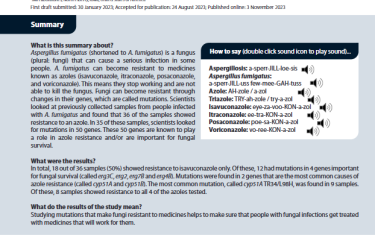
Aspergillus fumigatus (shortened to A. fumigatus) is a fungus (plural: fungi) that can cause a serious infection in some people. A. fumigatus can become resistant to medicines known as azoles (isavuconazole, itraconazole, posaconazole, and voriconazole). This means they stop working and are not able to kill the fungus. Fungi can become resistant through changes in their genes, which are called mutations. Scientists looked at previously collected samples from people infected with A. fumigatus and found that 36 of the samples showed resistance to an azole. In 35 of these samples, scientists looked for mutations in 50 genes. These 50 genes are known to play a role in azole resistance and/or are important for fungal survival.
15th Nov 2023

Plain language summary: A. fumigatus fungi samples that show resistance to antifungal medicines have changes in their genes

20th May 2022

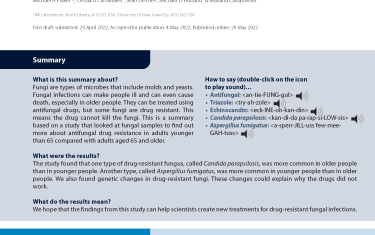
Plain language summary: Does a person’s age affect how common fungal infections are and how well drugs can kill the infections?

Copyright © 2026 · Plain Language Summaries · Terms and conditions · Privacy policy · Cookie policy