Plain Language Summaries is part of Taylor & Francis Group.

  • Taylor & Francis
  • About us
  • Our journals
  • Our Digital Hubs

Taylor & Francis Group is a trading division of Informa that operates through various Informa legal entities including, but not limited to, Informa UK Limited, with the registered address at 5 Howick Place, London, SW1P 1WG, UK.

Taylor & Francis
logo
 
  • How to
  • FAQs
  • Publications
  • Advisory Panel
    • Plain Language Advisors
    • Scientific Content Advisors
  • Supporters
  • Blog
  • About us
  • Contact Us

durvalumab

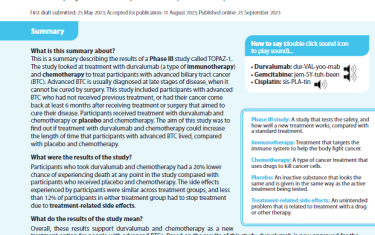
This is a summary describing the results of a Phase III study called TOPAZ-1. The study looked at treatment with durvalumab (a type of immunotherapy) and chemotherapy to treat participants with advanced biliary tract cancer (BTC). Advanced BTC is usually diagnosed at late stages of disease, when it cannot be cured by surgery. This study included participants with advanced BTC who had not received previous treatment, or had their cancer come back at least 6 months after receiving treatment or surgery that aimed to cure their disease. Participants received treatment with durvalumab and chemotherapy or placebo and chemotherapy. The aim of this study was to find out if treatment with durvalumab and chemotherapy could increase the length of time that participants with advanced BTC lived, compared with placebo and chemotherapy.
6th Oct 2023

The TOPAZ-1 study: a plain language summary describing durvalumab and chemotherapy for advanced biliary tract cancer

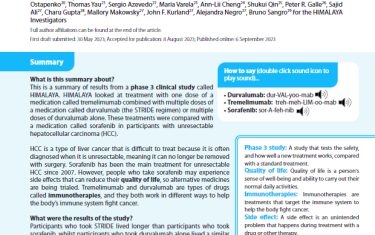
This is a summary of results from a phase 3 clinical study called HIMALAYA. HIMALAYA looked at treatment with one dose of a medication called tremelimumab combined with multiple doses of a medication called durvalumab (the STRIDE regimen) or multiple doses of durvalumab alone. These treatments were compared with a medication called sorafenib in participants with unresectable hepatocellular carcinoma (HCC).HCC is a type of liver cancer that is difficult to treat because it is often diagnosed when it is unresectable, meaning it can no longer be removed with surgery. Sorafenib has been the main treatment for unresectable HCC since 2007. However, people who take sorafenib may experience side effects that can reduce their quality of life, so alternative medicines are being trialed. Tremelimumab and durvalumab are types of drugs called immunotherapies, and they both work in different ways to help the body’s immune system fight cancer
22nd Sep 2023

A plain language summary of the HIMALAYA study which looked at tremelimumab and durvalumab for unresectable hepatocellular carcinoma

Copyright © 2026 · Plain Language Summaries · Terms and conditions · Privacy policy · Cookie policy