Plain Language Summaries is part of Taylor & Francis Group.

  • Taylor & Francis
  • About us
  • Our journals
  • Our Digital Hubs

Taylor & Francis Group is a trading division of Informa that operates through various Informa legal entities including, but not limited to, Informa UK Limited, with the registered address at 5 Howick Place, London, SW1P 1WG, UK.

Taylor & Francis
logo
 
  • How to
  • FAQs
  • Publications
  • Advisory Panel
    • Plain Language Advisors
    • Scientific Content Advisors
  • Supporters
  • Blog
  • About us
  • Contact Us

Lungs and Airways

22nd Jan 2026

HARMONi-2 trial results comparing two treatments for PD-L1–positive non-small cell lung cancer: a plain language summary

28th Nov 2025

How alectinib performed against chemotherapy in ALINA study: a plain language summary

28th Nov 2025

Cystic fibrosis plain language summary: exploring gene therapy possibilities

18th Jul 2025

Plain language summary: living with advancing pulmonary fibrosis – patient experiences and treatment approaches

17th Jul 2025

Plain language summary: understanding how people with asthma or COPD and their healthcare providers make decisions about treatment

22nd Apr 2025

Plain language summary: Expert advice on supporting people with obstructive sleep apnea and excessive daytime sleepiness

26th Mar 2025

Plain language summary: Sotorasib vs. docetaxel for treated KRAS G12C–mutated non–small–cell lung cancer

21st Feb 2025

Plain language summary of the XALOC-1 program: Real-world study on benralizumab for severe eosinophilic asthma across different biologic treatments and clinical subgroups

22nd Jan 2025

Plain language summary of the SHAMAL study on benralizumab treatment for severe eosinophilic asthma

17th Jan 2025

Inhaled molgramostim for treating autoimmune pulmonary alveolar proteinosis (aPAP): plain language summary of the IMPALA trial

23rd Sep 2024

Benralizumab treatment outcomes in patients with severe eosinophilic asthma: plain language summary of the ANANKE study

Two ongoing clinical studies are part of a programme called FIBRONEER. The FIBRONEER studies are testing the drug BI 1015550 as a treatment for people with idiopathic pulmonary fibrosis (IPF) and people with progressive pulmonary fibrosis (PPF).IPF is a severe lung disease where scar tissue builds up in the lungs. The ‘idiopathic’ part means that doctors do not know the cause of the lung scarring. PPF is a general term to describe the worsening of lung scarring in any disease where scar tissue forms in the lungs, both from known causes such as other underlying diseases and for unknown reasons. While IPF can be considered to be a typical form of worsening lung scarring, in clinical studies, IPF and PPF are usually considered separately. In both IPF and PPF, scar tissue builds up in the lungs, making them smaller and no longer able to take in oxygen well. This leads to difficulty in breathing and getting oxygen to the tissues, making it difficult to perform daily activities and reducing the patient’s quality of life.
27th Feb 2024

A plain language summary: BI 1015550 for idiopathic pulmonary fibrosis and progressive pulmonary fibrosis

This is a summary of the results of a study called PHAROS. This study looked at combination treatment with encorafenib (BRAFTOVI®) and binimetinib (MEKTOVI®). This combination of medicines was studied in people with metastatic non-small-cell lung cancer (NSCLC). NSCLC is the most common type of lung cancer. Metastatic means that the cancer has spread to other parts of the body. All people in this study had a type of NSCLC that has a change in a gene called BRAF termed a BRAF V600E mutation. A gene is a part of the DNA that has instructions for making things that your body needs to work, and the BRAF V600E mutation contributes to the growth of the lung cancer.
23rd Feb 2024

A plain language summary looking at the combination of encorafenib and binimetinib for people with BRAF V600E-mutant metastatic non-small cell lung cancer

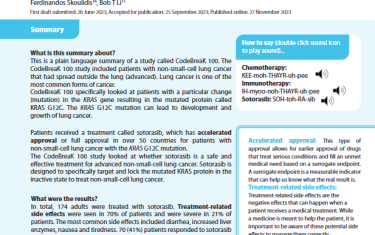
This is a plain language summary of a study called CodeBreaK 100. The CodeBreaK 100 study included patients with non-small-cell lung cancer that had spread outside the lung (advanced). Lung cancer is one of the most common forms of cancer.CodeBreaK 100 specifically looked at patients with a particular change (mutation) in the KRAS gene resulting in the mutated protein called KRAS G12C. The KRAS G12C mutation can lead to development and growth of lung cancer.
22nd Jan 2024

A plain language summary looking at the long-term benefit of sotorasib in patients with KRAS G12C–mutated non–small-cell lung cancer

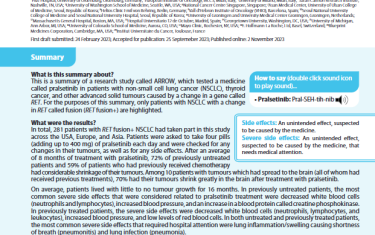
This is a summary of a research study called ARROW, which tested a medicine called pralsetinib in patients with non-small cell lung cancer (NSCLC), thyroid cancer, and other advanced solid tumours caused by a change in a gene called RET. For the purposes of this summary, only patients with NSCLC with a change in RET called fusion (RET fusion+) are highlighted
14th Nov 2023

A plain language summary of the ARROW study: pralsetinib in patients with RET fusion–positive non-small cell lung cancer

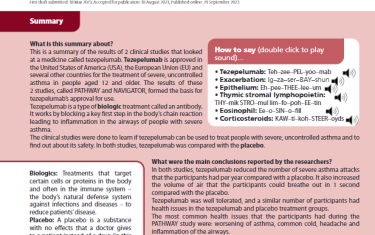
This is a summary of the results of 2 clinical studies that looked at a medicine called tezepelumab. Tezepelumab is approved in the United States of America (USA), the European Union (EU) and several other countries for the treatment of severe, uncontrolled asthma in people aged 12 and older. The results of these 2 studies, called PATHWAY and NAVIGATOR, formed the basis for tezepelumab’s approval for use. Tezepelumab is a type of biologic treatment called an antibody. It works by blocking a key first step in the body’s chain reaction leading to inflammation in the airways of people with severe asthma.The clinical studies were done to learn if tezepelumab can be used to treat people with severe, uncontrolled asthma and to find out about its safety. In both studies, tezepelumab was compared with the placebo
29th Sep 2023

A plain language summary of the PATHWAY and NAVIGATOR studies: tezepelumab for the treatment of severe asthma

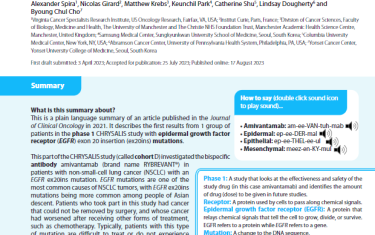
his is a plain language summary of an article published in the Journal of Clinical Oncology in 2021. It describes the first results from 1 group of patients in the phase 1 CHRYSALIS study with epidermal growth factorreceptor (EGFR) exon 20 insertion (ex20ins) mutations. This part of the CHRYSALIS study (called cohort D) investigated the bispecific antibody amivantamab (brand name RYBREVANT®) in patients with non-small-cell lung cancer (NSCLC) with an EGFR ex20ins mutation. EGFR mutations are one of the most common causes of NSCLC tumors, with EGFR ex20ins mutations being more common among people of Asian descent. Patients who took part in this study had cancer that could not be removed by surgery, and whose cancer had worsened after receiving other forms of treatment, such as chemotherapy. Typically, patients with this type of mutation are difficult to treat or do not experience treatment response with commonly used therapies that target EGFR.
17th Aug 2023

Plain Language Summary: looking at patients with EGFR exon 20 insertion-mutated non-small-cell lung cancer who received amivantamab in the CHRYSALIS study

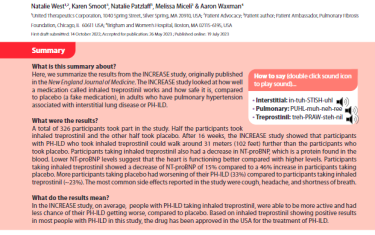
Here, we summarize the results from the INCREASE study, originally published in the New England Journal of Medicine. The INCREASE study looked at how well a medication called inhaled treprostinil works and how safe it is, compared to placebo (a fake medication), in adults who have pulmonary hypertension associated with interstitial lung disease or PH-ILD.
20th Jul 2023

A Plain Language Summary on the INCREASE study: inhaled treprostinil (Tyvaso) for the treatment of pulmonary hypertension due to interstitial lung disease

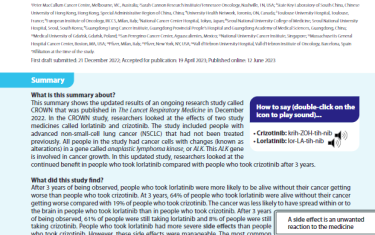
This summary shows the updated results of an ongoing research study called CROWN that was published in The Lancet Respiratory Medicine in December 2022. In the CROWN study, researchers looked at the effects of two study medicines called lorlatinib and crizotinib. The study included people with advanced non-small-cell lung cancer (NSCLC) that had not been treated previously. All people in the study had cancer cells with changes (known as alterations) in a gene called anaplastic lymphoma kinase, or ALK. This ALK gene is involved in cancer growth. In this updated study, researchers looked at the continued benefit in people who took lorlatinib compared with people who took crizotinib after 3 years.
21st Jun 2023

Plain Language Summary: updated results from the CROWN study comparing lorlatinib with crizotinib in people with advanced non-small-cell lung cancer

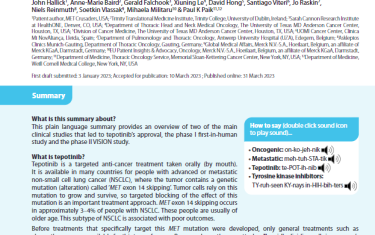
This plain language summary provides an overview of two of the main clinical studies that led to tepotinib’s approval, the phase I first-in-human study and the phase II VISION study
23rd May 2023

Plain Language Summary: tepotinib, a treatment for a subtype of non-small cell lung cancer called MET exon 14 skipping

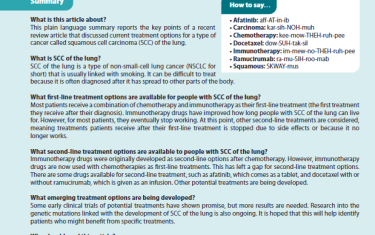
This plain language summary reports the key points of a recent review article that discussed current treatment options for a type of cancer called squamous cell carcinoma (SCC) of the lung.
23rd May 2023

Plain Language Summary: treatment considerations for patients with advanced squamous cell carcinoma of the lung

Copyright © 2026 · Plain Language Summaries · Terms and conditions · Privacy policy · Cookie policy