Plain Language Summaries is part of Taylor & Francis Group.

  • Taylor & Francis
  • About us
  • Our journals
  • Our Digital Hubs

Taylor & Francis Group is a trading division of Informa that operates through various Informa legal entities including, but not limited to, Informa UK Limited, with the registered address at 5 Howick Place, London, SW1P 1WG, UK.

Taylor & Francis
logo
 
  • How to
  • FAQs
  • Publications
  • Advisory Panel
    • Plain Language Advisors
    • Scientific Content Advisors
  • Supporters
  • Blog
  • About us
  • Contact Us

metastasis

25th Feb 2026

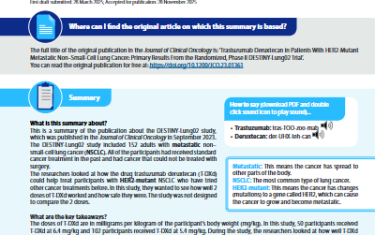
Plain language summary: DESTINY-Lung02 study of trastuzumab deruxtecan for HER2-mutant metastatic non-small-cell lung cancer

26th Mar 2025

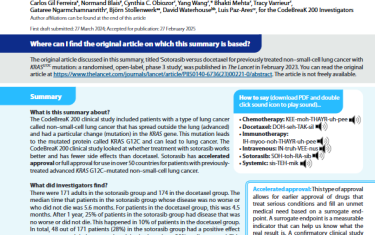
Plain language summary: Sotorasib vs. docetaxel for treated KRAS G12C–mutated non–small–cell lung cancer

21st Feb 2025

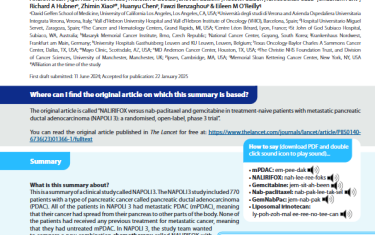
Plain language summary of the NAPOLI 3 study: comparing NALIRIFOX with nab-paclitaxel and gemcitabine for metastatic pancreatic cancer

11th Feb 2025

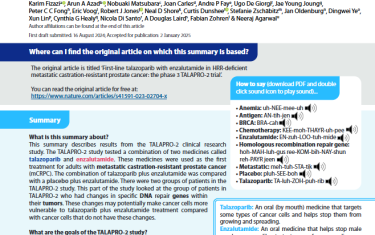
Plain language summary of the TALAPRO-2 study: Talazoparib plus enzalutamide versus placebo plus enzalutamide for advanced prostate cancer with specific DNA repair gene alterations

15th Nov 2024

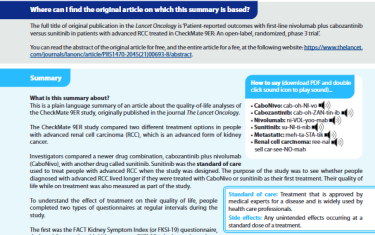
Quality of life in CheckMate 9ER: cabozantinib and nivolumab for advanced renal cell carcinoma

28th Aug 2024

DESTINY-Lung01 Study: a plain language summary on Trastuzumab deruxtecan in HER2-mutant non-small-cell lung cancer

30th Jul 2024

Plain language summary of Trifluridine/Tipiracil and Bevacizumab for refractory metastatic colorectal cancer: The SUNLIGHT Study

30th Jul 2024

Plain language summary of TALAPRO-2 study: Talazoparib plus enzalutamide vs. placebo plus enzalutamide for advanced prostate cancer

Sacituzumab govitecan (brand name: TRODELVY®) is a new treatment being studied for people with a type of bladder cancer, called urothelial cancer, that has progressed to a locally advanced or metastatic stage. Locally advanced and metastatic urothelial cancer are usually treated with platinum-based chemotherapy. Metastatic urothelial cancer is also treated with immune checkpoint inhibitors. There are few treatment options for people whose cancer gets worse after receiving these treatments. Sacituzumab govitecan is a suitable treatment option for most people with urothelial cancer because it aims to deliver an anti-cancer drug directly to the cancer in an attempt to limit the potential harmful side effects on healthy cells. This is a summary of a clinical study called TROPHY-U-01, focusing on the first group of participants, referred to as Cohort 1. All participants in Cohort 1 received sacituzumab govitecan
30th Apr 2024

Sacituzumab govitecan use in people with locally advanced or metastatic urothelial cancer- a plain language summary of the TROPHY-U-01 study

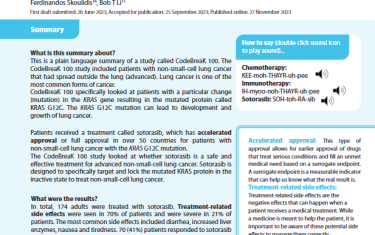
This is a plain language summary of a study called CodeBreaK 100. The CodeBreaK 100 study included patients with non-small-cell lung cancer that had spread outside the lung (advanced). Lung cancer is one of the most common forms of cancer.CodeBreaK 100 specifically looked at patients with a particular change (mutation) in the KRAS gene resulting in the mutated protein called KRAS G12C. The KRAS G12C mutation can lead to development and growth of lung cancer.
22nd Jan 2024

A plain language summary looking at the long-term benefit of sotorasib in patients with KRAS G12C–mutated non–small-cell lung cancer

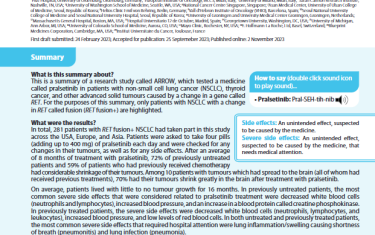
This is a summary of a research study called ARROW, which tested a medicine called pralsetinib in patients with non-small cell lung cancer (NSCLC), thyroid cancer, and other advanced solid tumours caused by a change in a gene called RET. For the purposes of this summary, only patients with NSCLC with a change in RET called fusion (RET fusion+) are highlighted
14th Nov 2023

A plain language summary of the ARROW study: pralsetinib in patients with RET fusion–positive non-small cell lung cancer

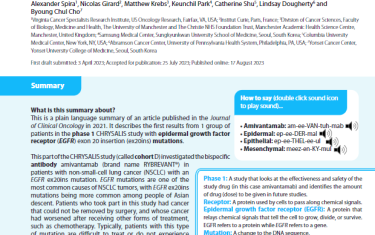
his is a plain language summary of an article published in the Journal of Clinical Oncology in 2021. It describes the first results from 1 group of patients in the phase 1 CHRYSALIS study with epidermal growth factorreceptor (EGFR) exon 20 insertion (ex20ins) mutations. This part of the CHRYSALIS study (called cohort D) investigated the bispecific antibody amivantamab (brand name RYBREVANT®) in patients with non-small-cell lung cancer (NSCLC) with an EGFR ex20ins mutation. EGFR mutations are one of the most common causes of NSCLC tumors, with EGFR ex20ins mutations being more common among people of Asian descent. Patients who took part in this study had cancer that could not be removed by surgery, and whose cancer had worsened after receiving other forms of treatment, such as chemotherapy. Typically, patients with this type of mutation are difficult to treat or do not experience treatment response with commonly used therapies that target EGFR.
17th Aug 2023

Plain Language Summary: looking at patients with EGFR exon 20 insertion-mutated non-small-cell lung cancer who received amivantamab in the CHRYSALIS study

Copyright © 2026 · Plain Language Summaries · Terms and conditions · Privacy policy · Cookie policy