Plain Language Summaries is part of Taylor & Francis Group.

  • Taylor & Francis
  • About us
  • Our journals
  • Our Digital Hubs

Taylor & Francis Group is a trading division of Informa that operates through various Informa legal entities including, but not limited to, Informa UK Limited, with the registered address at 5 Howick Place, London, SW1P 1WG, UK.

Taylor & Francis
logo
 
  • How to
  • FAQs
  • Publications
  • Advisory Panel
    • Plain Language Advisors
    • Scientific Content Advisors
  • Supporters
  • Blog
  • About us
  • Contact Us

nonmetastatic castration-resistant prostate cancer

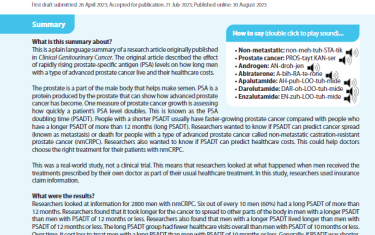
This is a plain language summary of a research article originally published in Clinical Genitourinary Cancer. The original article described the effect of rapidly rising prostate-specific antigen (PSA) levels on how long men with a type of advanced prostate cancer live and their healthcare costs.The prostate is a part of the male body that helps make semen. PSA is a protein produced by the prostate that can show how advanced prostate cancer has become. One measure of prostate cancer growth is assessing how quickly a patient’s PSA level doubles. This is known as the PSA doubling time (PSADT). People with a shorter PSADT usually have faster-growing prostate cancer compared with people who have a longer PSADT of more than 12 months (long PSADT). Researchers wanted to know if PSADT can predict cancer spread (known as metastasis) or death for people with a type of advanced prostate cancer called non-metastatic castration-resistant prostate cancer (nmCRPC). Researchers also wanted to know if PSADT can predict healthcare costs. This could help doctors choose the right treatment for their patients with nmCRPC.This was a real-world study, not a clinical trial. This means that researchers looked at what happened when men received the treatments prescribed by their own doctor as part of their usual healthcare treatment. In this study, researchers used insurance claim information.
12th Sep 2023

A plain language summary describing the effect of rapidly rising prostate-specific antigen (PSA) levels on how long men with a type of advanced prostate cancer live and their healthcare costs

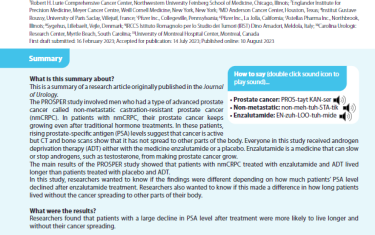
This is a summary of a research article originally published in the Journal of Urology. The PROSPER study involved men who had a type of advanced prostate cancer called non-metastatic castration-resistant prostate cancer (nmCRPC). In patients with nmCRPC, their prostate cancer keeps growing even after traditional hormone treatments. In these patients, rising prostate-specific antigen (PSA) levels suggest that cancer is active but CT and bone scans show that it has not spread to other parts of the body. Everyone in this study received androgen deprivation therapy (ADT) either with the medicine enzalutamide or a placebo. Enzalutamide is a medicine that can slow or stop androgens, such as testosterone, from making prostate cancer grow. The main results of the PROSPER study showed that patients with nmCRPC treated with enzalutamide and ADT lived longer than patients treated with placebo and ADT. In this study, researchers wanted to know if the findings were different depending on how much patients’ PSA level declined after enzalutamide treatment. Researchers also wanted to know if this made a difference in how long patients lived without the cancer spreading to other parts of their body
10th Aug 2023

A plain language summary looking at whether declines in prostate-specific antigen level indicates how long patients with advanced prostate cancer will live when treated with enzalutamide

25th Nov 2022

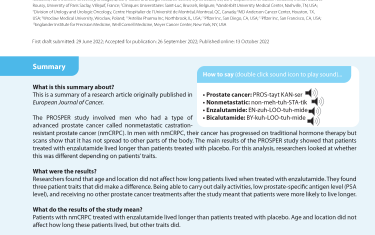
Which traits affect how long patients with advanced prostate cancer live when treated with enzalutamide?

Copyright © 2026 · Plain Language Summaries · Terms and conditions · Privacy policy · Cookie policy