Plain Language Summaries is part of Taylor & Francis Group.

  • Taylor & Francis
  • About us
  • Our journals
  • Our Digital Hubs

Taylor & Francis Group is a trading division of Informa that operates through various Informa legal entities including, but not limited to, Informa UK Limited, with the registered address at 5 Howick Place, London, SW1P 1WG, UK.

Taylor & Francis
logo
 
  • How to
  • FAQs
  • Publications
  • Advisory Panel
    • Plain Language Advisors
    • Scientific Content Advisors
  • Supporters
  • Blog
  • About us
  • Contact Us

Blood

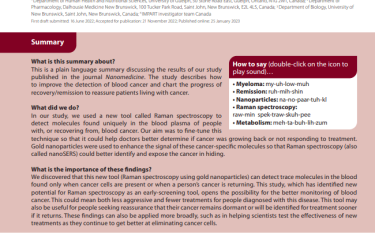
Screenshot of first page of the PLSP
16th Apr 2026

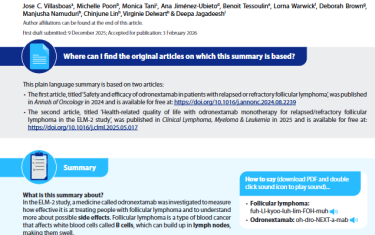
A plain language summary on the ELM-2 study: odronextamab for relapsed/refractory follicular lymphoma

25th Feb 2026

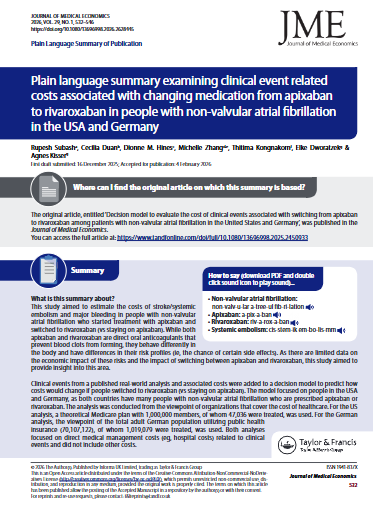
Plain language summary of medical event costs following medication change from apixaban to rivaroxaban in non-valvular atrial fibrillation patients across USA and Germany

25th Feb 2026

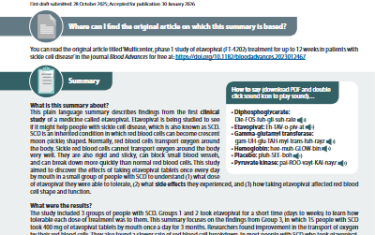
Plain language summary of the first etavopivat clinical study in sickle cell disease

25th Feb 2026

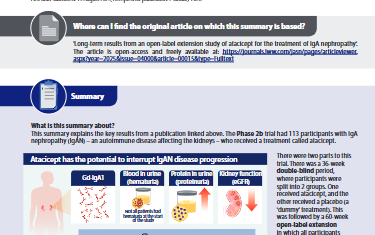
Long-term outcomes of atacicept therapy in IgA nephropathy patients: a plain language summary

26th Jan 2026

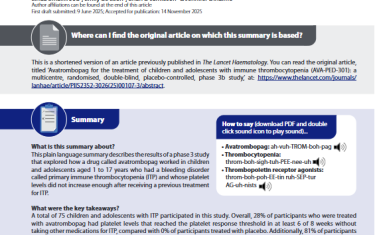
Plain language summary: Avatrombopag therapy for young patients with immune thrombocytopenia

23rd Oct 2025

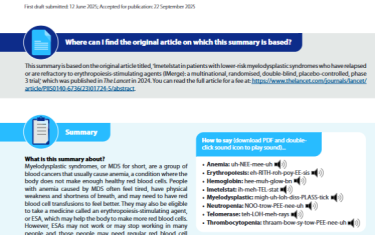
Plain language summary of the IMerge Phase 3 study: imetelstat vs placebo in lower-risk myelodysplastic syndrome patients with anemia

22nd Sep 2025

LOCK IT-100 study: A plain language summary of the taurolidine/heparin catheter lock solution

30th Jul 2025

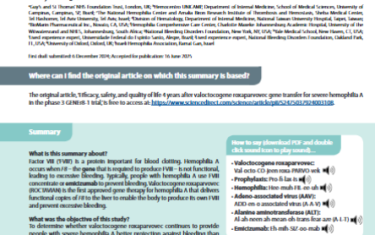
Plain language summary: 4-year outcomes from testing valoctocogene roxaparvovec gene therapy in people with hemophilia A

27th May 2025

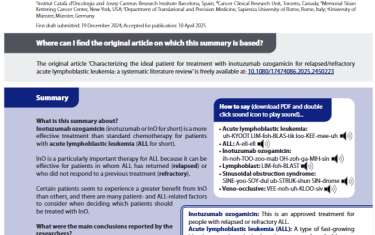
Plain language summary: finding the best candidates for inotuzumab ozogamicin treatment among acute lymphoblastic leukemia patients

17th Mar 2025

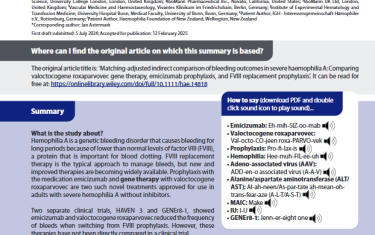
A plain language summary comparing bleeding outcomes after valoctocogene roxaparvovec gene therapy versus emicizumab prophylaxis

24th Feb 2025

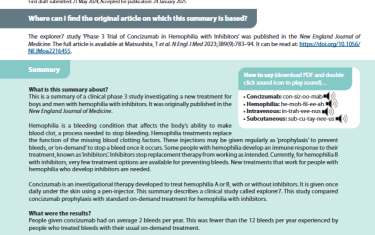
A plain language summary of the phase 3 explorer7 study of concizumab prophylaxis for people with hemophilia with inhibitors

22nd Jan 2025

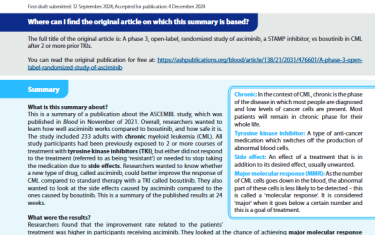
Plain language summary of the ASCEMBL study: comparing asciminib and bosutinib after multiple prior treatments for chronic myeloid leukemia

13th Jan 2025

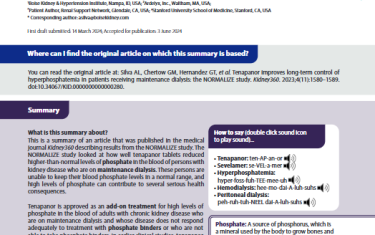
Tenapanor enhances long-term management of elevated blood phosphate levels in patients undergoing maintenance dialysis: a plain language summary of the NORMALIZE study

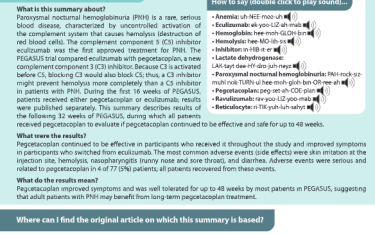
Paroxysmal nocturnal hemoglobinuria (PNH) is a rare, seriousblood disease, characterized by uncontrolled activation ofthe complement system that causes hemolysis (destruction ofred blood cells). The complement component 5 (C5) inhibitoreculizumab was the first approved treatment for PNH. ThePEGASUS trial compared eculizumab with pegcetacoplan, a newcomplement component 3 (C3) inhibitor. Because C3 is activatedbefore C5, blocking C3 would also block C5; thus, a C3 inhibitormight prevent hemolysis more completely than a C5 inhibitorin patients with PNH. During the first 16 weeks of PEGASUS,patients received either pegcetacoplan or eculizumab; resultswere published separately. This summary describes results ofthe following 32 weeks of PEGASUS, during which all patientsreceived pegcetacoplan to evaluate if pegcetacoplan continued to be effective and safe for up to 48 weeks
26th Jun 2024

PEGASUS study: A plain language summary looking treatment of paroxysmal nocturnal hemoglobinuria with pegcetacoplan for 48 weeks

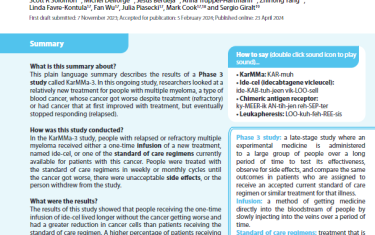
This plain language summary describes the results of a Phase 3 study called KarMMa-3. In this ongoing study, researchers looked at a relatively new treatment for people with multiple myeloma, a type of blood cancer, whose cancer got worse despite treatment (refractory) or had cancer that at first improved with treatment, but eventually stopped responding (relapsed)
30th Apr 2024

KarMMa-3 study: A plain language summary looking at the effectiveness of ide-cel for relapsed/refractory multiple myeloma

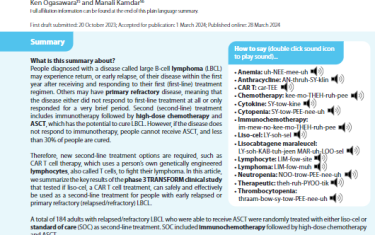
eople diagnosed with a disease called large B-cell lymphoma (LBCL) may experience return, or early relapse, of their disease within the first year after receiving and responding to their first (first-line) treatment regimen. Others may have primary refractory disease, meaning that the disease either did not respond to first-line treatment at all or only responded for a very brief period. Second (second-line) treatment includes immunotherapy followed by high-dose chemotherapy and ASCT, which has the potential to cure LBCL. However, if the disease does not respond to immunotherapy, people cannot receive ASCT, and less than 30% of people are cured.Therefore, new second-line treatment options are required, such as CAR T cell therapy, which uses a person’s own genetically engineered lymphocytes, also called T cells, to fight their lymphoma. In this article, we summarize the key results of the phase 3 TRANSFORM clinical studythat tested if liso-cel, a CAR T cell treatment, can safely and effectively be used as a second-line treatment for people with early relapsed or primary refractory (relapsed/refractory) LBCL
30th Apr 2024

A plain language summary on the TRANSFORM study: liso-cel as a second treatment regimen for large B-cell lymphoma

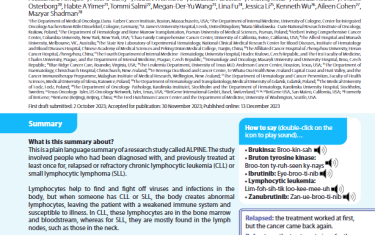
This is a plain language summary of a research study called ALPINE. The study involved people who had been diagnosed with, and previously treated at least once for, relapsed or refractory chronic lymphocytic leukemia (CLL) or small lymphocytic lymphoma (SLL)
22nd Jan 2024

Zanubrutinib or ibrutinib in chronic lymphocytic leukemia that is resistant to treatment or has come back after treatment- a plain language summary

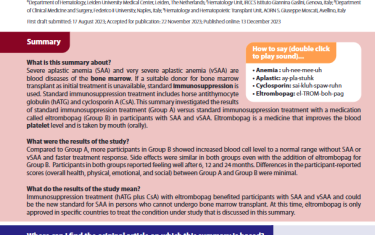
Severe aplastic anemia (SAA) and very severe aplastic anemia (vSAA) are blood diseases of the bone marrow. If a suitable donor for bone marrow transplant as initial treatment is unavailable, standard immunosuppression is used. Standard immunosuppression treatment includes horse antithymocyte globulin (hATG) and cyclosporin A (CsA). This summary investigated the results of standard immunosuppression treatment (Group A) versus standard immunosuppression treatment with a medication called eltrombopag (Group B) in participants with SAA and vSAA. Eltrombopag is a medicine that improves the blood platelet level and is taken by mouth (orally).
22nd Jan 2024

A plain language summary of the RACE study looking at adding eltrombopag to standard treatment of severe aplastic anemia

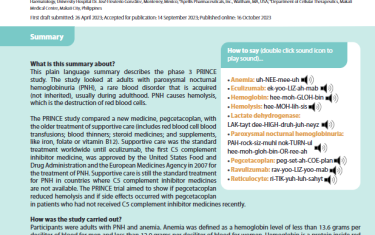
This plain language summary describes the phase 3 PRINCE study. The study looked at adults with paroxysmal nocturnal hemoglobinuria (PNH), a rare blood disorder that is acquired (not inherited), usually during adulthood. PNH causes hemolysis, which is the destruction of red blood cells.
20th Nov 2023

A plain language summary comparing pegcetacoplan with supportive care for 26 weeks in participants with paroxysmal nocturnal hemoglobinuria

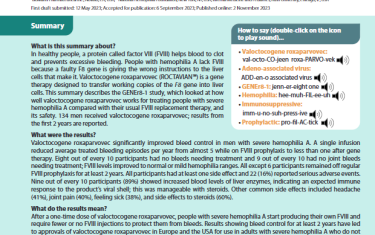
In healthy people, a protein called factor VIII (FVIII) helps blood to clot and prevents excessive bleeding. People with hemophilia A lack FVIII because a faulty F8 gene is giving the wrong instructions to the liver cells that make it. Valoctocogene roxaparvovec (ROCTAVIAN™) is a gene therapy designed to transfer working copies of the F8 gene into liver cells. This summary describes the GENEr8-1 study, which looked at how well valoctocogene roxaparvovec works for treating people with severe hemophilia A compared with their usual FVIII replacement therapy, and its safety. 134 men received valoctocogene roxaparvovec; results from the first 2 years are reported.
14th Nov 2023

Plain Language Summary of Publication article: the GENEr8-1 study of valoctocogene roxaparvovec gene therapy for hemophilia A

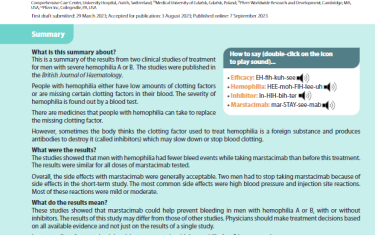
This is a summary of the results from two clinical studies of treatment for men with severe hemophilia A or B. The studies were published in the British Journal of Haematology. People with hemophilia either have low amounts of clotting factors or are missing certain clotting factors in their blood. The severity of hemophilia is found out by a blood test. There are medicines that people with hemophilia can take to replace the missing clotting factor. However, sometimes the body thinks the clotting factor used to treat hemophilia is a foreign substance and produces antibodies to destroy it (called inhibitors) which may slow down or stop blood clotting
22nd Sep 2023

A plain language summary looking at marstacimab treatment for people with severe hemophilia A or B

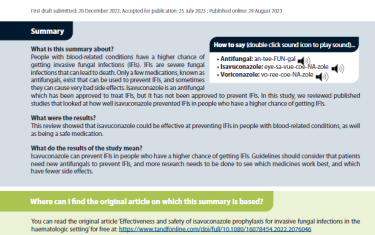
People with blood-related conditions have a higher chance of getting invasive fungal infections (IFIs). IFIs are severe fungal infections that can lead to death. Only a few medications, known as antifungals, exist that can be used to prevent IFIs, and sometimes they can cause very bad side effects. Isavuconazole is an antifungal which has been approved to treat IFIs, but it has not been approved to prevent IFIs. In this study, we reviewed published studies that looked at how well isavuconazole prevented IFIs in people who have a higher chance of getting IFIs
29th Aug 2023

Plain language summary: preventing fungal infections with isavuconazole in people with blood-related conditions

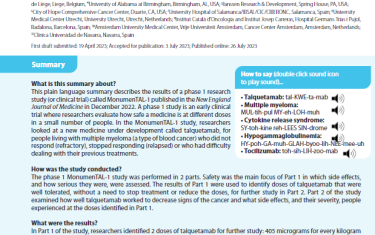
This plain language summary describes the results of a phase 1 research study (or clinical trial) called MonumenTAL-1 published in the New England Journal of Medicine in December 2022. A phase 1 study is an early clinical trial where researchers evaluate how safe a medicine is at different doses in a small number of people. In the MonumenTAL-1 study, researchers looked at a new medicine under development called talquetamab, for people living with multiple myeloma (a type of blood cancer) who did not respond (refractory), stopped responding (relapsed) or who had difficulty dealing with their previous treatments.
9th Aug 2023

The MonumenTAL-1 study of talquetamab in people with relapsed or refractory multiple myeloma- a plain language summary

1st Mar 2023

Plain language summary of a fingerprinting technique to monitor blood cancer
Copyright © 2026 · Plain Language Summaries · Terms and conditions · Privacy policy · Cookie policy