Plain Language Summaries is part of Taylor & Francis Group.

  • Taylor & Francis
  • About us
  • Our journals
  • Our Digital Hubs

Taylor & Francis Group is a trading division of Informa that operates through various Informa legal entities including, but not limited to, Informa UK Limited, with the registered address at 5 Howick Place, London, SW1P 1WG, UK.

Taylor & Francis
logo
 
  • How to
  • FAQs
  • Publications
  • Advisory Panel
    • Plain Language Advisors
    • Scientific Content Advisors
  • Supporters
  • Blog
  • About us
  • Contact Us

clinical trial

Screenshot of first page of the PLSP
16th Apr 2026

A plain language summary on the ELM-2 study: odronextamab for relapsed/refractory follicular lymphoma

22nd Jan 2026

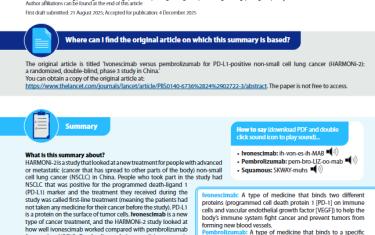
HARMONi-2 trial results comparing two treatments for PD-L1–positive non-small cell lung cancer: a plain language summary

A screenshot of the PLSP article
19th Sep 2025

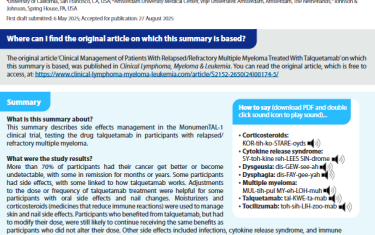
A plain language summary of the MonumenTAL-1 study: talquetamab for relapsed/ refractory multiple myeloma

16th Sep 2025

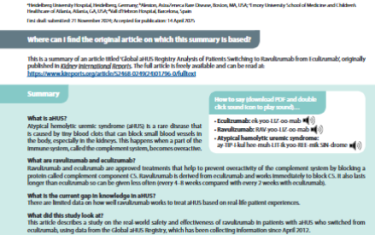
Plain language summary: Global Registry data shows patients with aHUS can safely and effectively change from eculizumab to ravulizumab treatment

15th Sep 2025

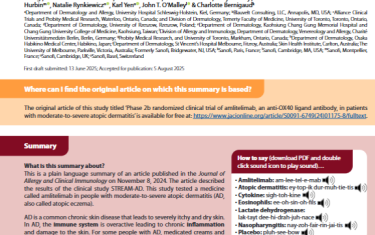
Evaluating an OX40 ligand-blocking antibody for eczema treatment in the STREAM-AD clinical trial: a plain language summary

30th Jul 2025

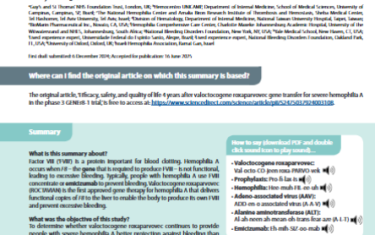
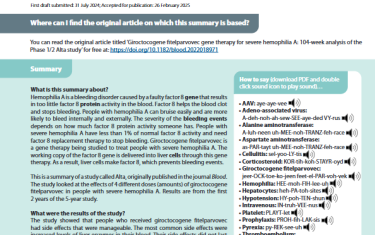
Plain language summary: 4-year outcomes from testing valoctocogene roxaparvovec gene therapy in people with hemophilia A

13th May 2025

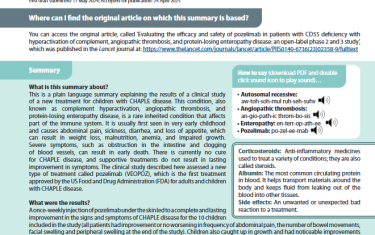
Understanding pozelimab’s impact on young CHAPLE disease patients : a plain language summary

25th Apr 2025

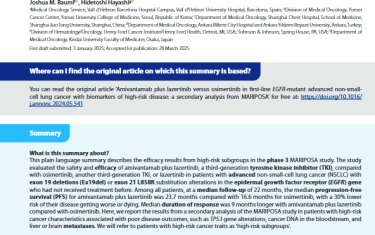
Plain language summary of first-line treatment with amivantamab-lazertinib for high-risk EGFR-positive lung cancer from the MARIPOSA study

22nd Apr 2025

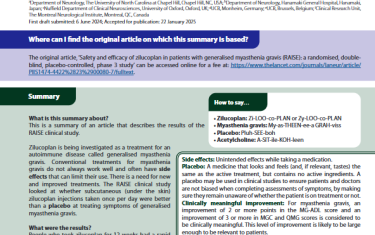
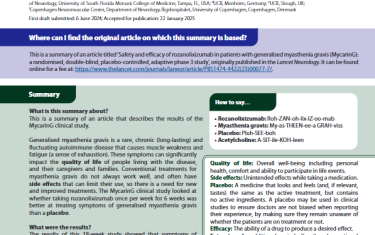
Daily zilucoplan self-injections eased symptoms in people with generalized myasthenia gravis: Plain Language Summary of the RAISE Study

22nd Apr 2025

Plain language summary of the MycarinG study: Rozanolixizumab eased symptoms in people with generalized myasthenia gravis

21st Mar 2025

A plain language summary of the two-year results from a five-year study on giroctocogene fitelparvovec gene therapy for individuals with severe hemophilia A

8th Nov 2024

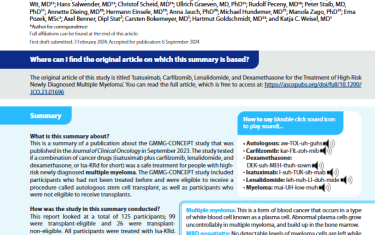
Isatuximab with carfilzomib, lenalidomide, and dexamethasone for treating high-risk, newly diagnosed multiple myeloma: A plain language summary

18th Oct 2024

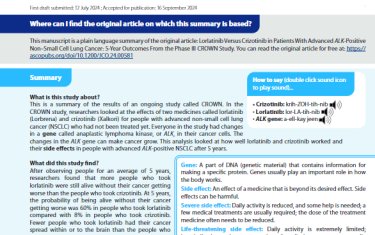
5-year results from the CROWN study of lorlatinib vs crizotinib in non-small-cell lung cancer

23rd Sep 2024

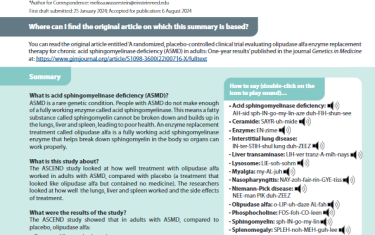
Plain language summary of the ASCEND study on one-year treatment outcomes with olipudase alfa in adults with acid sphingomyelinase deficiency (ASMD)

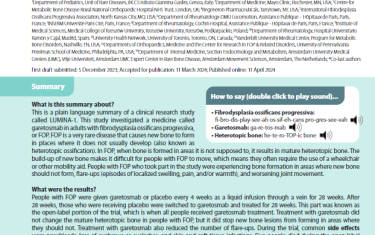
his is a plain language summary of a clinical research study called LUMINA-1. This study investigated a medicine called garetosmab in adults with fibrodysplasia ossificans progressiva, or FOP. FOP is a very rare disease that causes new bone to form in places where it does not usually develop (also known as heterotopic ossification). In FOP, when bone is formed in areas it is not supposed to, it results in mature heterotopic bone. The build-up of new bone makes it difficult for people with FOP to move, which means they often require the use of a wheelchair or other mobility aid. People with FOP who took part in the study were experiencing bone formation in areas where new bone should not form, flare-ups (episodes of localized swelling, pain, and/or warmth), and worsening joint movement
30th Apr 2024

LUMINA-1 study: A plain language summary looking at the effects of garetosmab in people with fibrodysplasia ossificans progressiva (FOP)

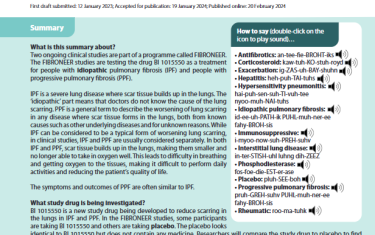
Two ongoing clinical studies are part of a programme called FIBRONEER. The FIBRONEER studies are testing the drug BI 1015550 as a treatment for people with idiopathic pulmonary fibrosis (IPF) and people with progressive pulmonary fibrosis (PPF).IPF is a severe lung disease where scar tissue builds up in the lungs. The ‘idiopathic’ part means that doctors do not know the cause of the lung scarring. PPF is a general term to describe the worsening of lung scarring in any disease where scar tissue forms in the lungs, both from known causes such as other underlying diseases and for unknown reasons. While IPF can be considered to be a typical form of worsening lung scarring, in clinical studies, IPF and PPF are usually considered separately. In both IPF and PPF, scar tissue builds up in the lungs, making them smaller and no longer able to take in oxygen well. This leads to difficulty in breathing and getting oxygen to the tissues, making it difficult to perform daily activities and reducing the patient’s quality of life.
27th Feb 2024

A plain language summary: BI 1015550 for idiopathic pulmonary fibrosis and progressive pulmonary fibrosis

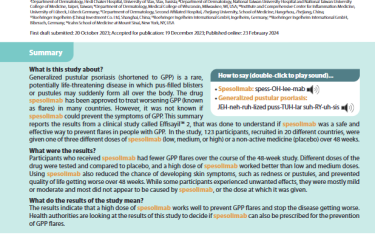
Generalized pustular psoriasis (shortened to GPP) is a rare, potentially life-threatening disease in which pus-filled blisters or pustules may suddenly form all over the body. The drug spesolimab has been approved to treat worsening GPP (known as flares) in many countries. However, it was not known if spesolimab could prevent the symptoms of GPP. This summary reports the results from a clinical study called Effisayil™ 2, that was done to understand if spesolimab was a safe and effective way to prevent flares in people with GPP. In the study, 123 participants, recruited in 20 different countries, were given one of three different doses of spesolimab (low, medium, or high) or a non-active medicine (placebo) over 48 weeks.
27th Feb 2024

A plain language summary looking at spesolimab treatment for the prevention of flares in people with generalized pustular psoriasis (GPP)

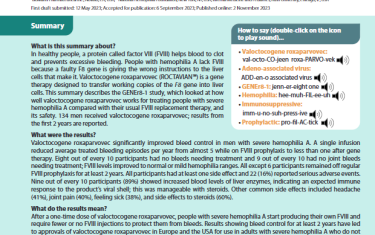
In healthy people, a protein called factor VIII (FVIII) helps blood to clot and prevents excessive bleeding. People with hemophilia A lack FVIII because a faulty F8 gene is giving the wrong instructions to the liver cells that make it. Valoctocogene roxaparvovec (ROCTAVIAN™) is a gene therapy designed to transfer working copies of the F8 gene into liver cells. This summary describes the GENEr8-1 study, which looked at how well valoctocogene roxaparvovec works for treating people with severe hemophilia A compared with their usual FVIII replacement therapy, and its safety. 134 men received valoctocogene roxaparvovec; results from the first 2 years are reported.
14th Nov 2023

Plain Language Summary of Publication article: the GENEr8-1 study of valoctocogene roxaparvovec gene therapy for hemophilia A

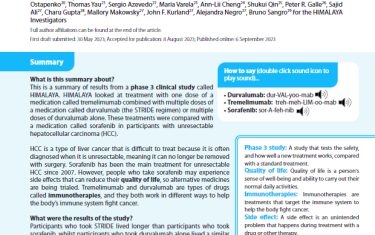
This is a summary of results from a phase 3 clinical study called HIMALAYA. HIMALAYA looked at treatment with one dose of a medication called tremelimumab combined with multiple doses of a medication called durvalumab (the STRIDE regimen) or multiple doses of durvalumab alone. These treatments were compared with a medication called sorafenib in participants with unresectable hepatocellular carcinoma (HCC).HCC is a type of liver cancer that is difficult to treat because it is often diagnosed when it is unresectable, meaning it can no longer be removed with surgery. Sorafenib has been the main treatment for unresectable HCC since 2007. However, people who take sorafenib may experience side effects that can reduce their quality of life, so alternative medicines are being trialed. Tremelimumab and durvalumab are types of drugs called immunotherapies, and they both work in different ways to help the body’s immune system fight cancer
22nd Sep 2023

A plain language summary of the HIMALAYA study which looked at tremelimumab and durvalumab for unresectable hepatocellular carcinoma

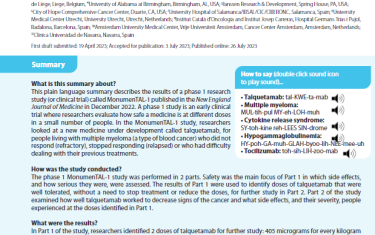
This plain language summary describes the results of a phase 1 research study (or clinical trial) called MonumenTAL-1 published in the New England Journal of Medicine in December 2022. A phase 1 study is an early clinical trial where researchers evaluate how safe a medicine is at different doses in a small number of people. In the MonumenTAL-1 study, researchers looked at a new medicine under development called talquetamab, for people living with multiple myeloma (a type of blood cancer) who did not respond (refractory), stopped responding (relapsed) or who had difficulty dealing with their previous treatments.
9th Aug 2023

The MonumenTAL-1 study of talquetamab in people with relapsed or refractory multiple myeloma- a plain language summary

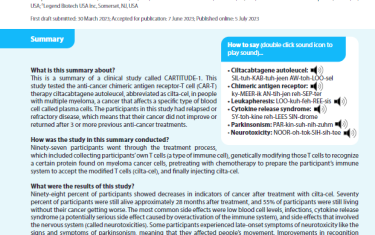
This is a summary of a clinical study called CARTITUDE-1. This study tested the anti-cancer chimeric antigen receptor-T cell (CAR-T ) therapy ciltacabtagene autoleucel, abbreviated as cilta-cel, in people with multiple myeloma, a cancer that affects a specific type of blood cell called plasma cells. The participants in this study had relapsed or refractory disease, which means that their cancer did not improve or returned after 3 or more previous anti-cancer treatments.
11th Jul 2023

Plain Language Summary: the CARTITUDE-1 study of ciltacabtagene autoleucel for the treatment of people with relapsed or refractory multiple myeloma

This summary explains the findings from a recent investigation that combined the results of over 1000 people from three clinical studies to understand the safety of evobrutinib.Evobrutinib is an oral medication (taken by mouth), being researched as a potential treatment for multiple sclerosis (MS). This medication was also investigated in rheumatoid arthritis (RA) and systemic lupus erythematosus (SLE).Over 1000 people have taken evobrutinib as part of three separate phase 2 clinical studies. These studies looked at how much of the drug should be taken, how safe the drug is, and how well it might work for treating a certain medical condition.
27th Jun 2023

Plain Language Summary: what can clinical studies tell us about evobrutinib, a potential treatment for multiple sclerosis

This is a summary of the article describing the results of the ORION-10 and ORION-11 studies, which was published in the New England Journal of Medicine in April 2020. The studies included adult participants with atherosclerotic cardiovascular disease (ASCVD). ASCVD happens when the blood vessels that carry blood from the heart to other areas of the body are blocked by fatty build-up (plaque) causing a heart attack, stroke, or other problems. High levels of low-density lipoprotein cholesterol (LDL cholesterol) in the blood can cause this fatty build-up. ORION-11 also included participants who were at high risk for ASCVD due to other conditions or high cholesterol that runs in the family
7th Jun 2023

Plain Language Summary: the ORION-10 and ORION-11 studies look at how well inclisiran works in people with high cholesterol

This is a summary of a clinical trial called MAIA. The trial tested 2 combinations of cancer drugs (daratumumab plus lenalidomide and dexamethasone compared with lenalidomide and dexamethasone) in people with newly diagnosed multiple myeloma. None of the participants who took part in the study had been treated before or were eligible to receive stem-cell transplants
23rd May 2023

Plain Language Summary: the MAIA study, daratumumab plus lenalidomide and dexamethasone for the treatment of people with newly diagnosed multiple myeloma

This plain language summary describes the main results from two similar research studies, “Study 1” and “Study 2”, which evaluated the use of a medication called daridorexant in patients with chronic insomnia disorder. These two studies were phase 3 clinical trials, which compared different doses of daridorexant to an inactive pill called a placebo, which looked and tasted similar to the daridorexant pill but did not contain daridorexant or any other active ingredient.
23rd May 2023

Plain Language Summary: the results from two phase 3 studies on the efficacy and safety of daridorexant in patients with chronic insomnia disorder:

25th Nov 2022

Trastuzumab and pertuzumab without chemotherapy in early-stage HER2+ breast cancer: a plain language summary of the PHERGain study
Copyright © 2026 · Plain Language Summaries · Terms and conditions · Privacy policy · Cookie policy