Plain Language Summaries is part of Taylor & Francis Group.

  • Taylor & Francis
  • About us
  • Our journals
  • Our Digital Hubs

Taylor & Francis Group is a trading division of Informa that operates through various Informa legal entities including, but not limited to, Informa UK Limited, with the registered address at 5 Howick Place, London, SW1P 1WG, UK.

Taylor & Francis
logo
 
  • How to
  • FAQs
  • Publications
  • Advisory Panel
    • Plain Language Advisors
    • Scientific Content Advisors
  • Supporters
  • Blog
  • About us
  • Contact Us

immunotherapy

25th Feb 2026

Managing specific adverse effects of teclistamab in multiple myeloma patients: a plain language summary

22nd Jan 2026

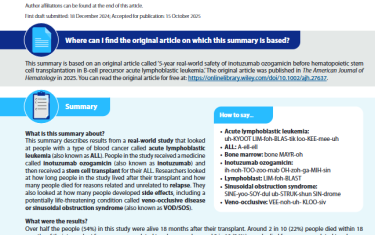
Plain language summary: results of pre-transplant inotuzumab ozogamicin treatment in acute lymphoblastic leukemia patients

28th Oct 2025

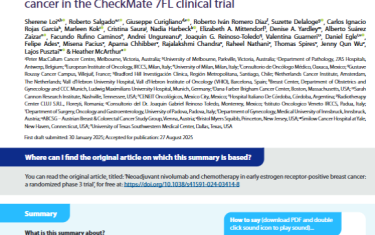
CheckMate 7FL trial: nivolumab versus placebo in estrogen-positive breast cancer treatment: plain language summary

27th May 2025

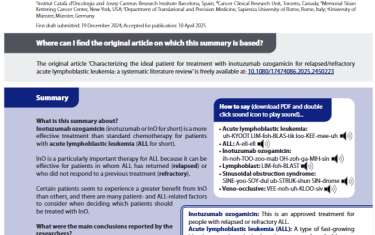
Plain language summary: finding the best candidates for inotuzumab ozogamicin treatment among acute lymphoblastic leukemia patients

23rd Apr 2025

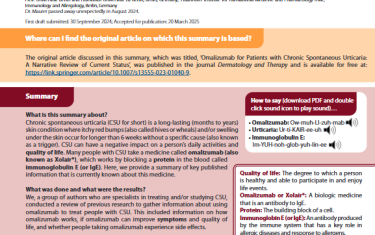
Plain language summary of a review on omalizumab for treating chronic spontaneous urticaria

23rd Jan 2025

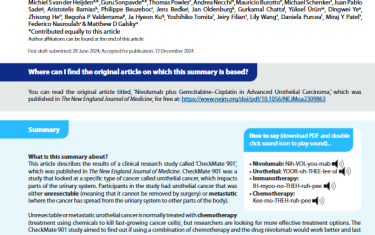
A plain language summary of the CheckMate 901 study: nivolumab combined with chemotherapy versus chemotherapy alone for advanced urothelial cancer

22nd Jan 2025

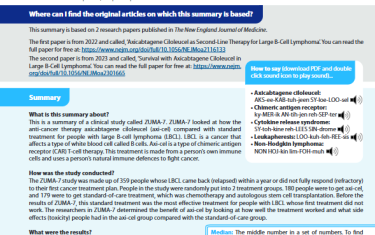
Plain language summary of the ZUMA-7 trial comparing axicabtagene ciloleucel to standard care for relapsed or refractory large B-cell lymphoma

21st Jan 2025

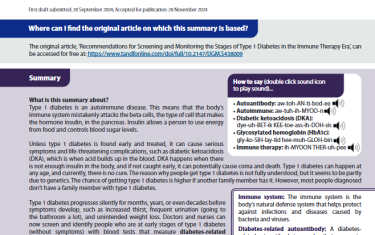
Understanding the different stages of type 1 diabetes and their management: a plain language summary

22nd Nov 2024

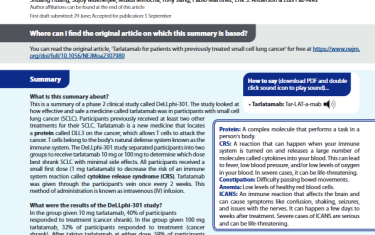
Plain language summary: tarlatamab for patients with previously treated small cell lung cancer

15th Aug 2024

Plain language summary of the CARTITUDE-4 study on ciltacabtagene autoleucel for treating relapsed or refractory multiple myeloma

Sacituzumab govitecan (brand name: TRODELVY®) is a new treatment being studied for people with a type of bladder cancer, called urothelial cancer, that has progressed to a locally advanced or metastatic stage. Locally advanced and metastatic urothelial cancer are usually treated with platinum-based chemotherapy. Metastatic urothelial cancer is also treated with immune checkpoint inhibitors. There are few treatment options for people whose cancer gets worse after receiving these treatments. Sacituzumab govitecan is a suitable treatment option for most people with urothelial cancer because it aims to deliver an anti-cancer drug directly to the cancer in an attempt to limit the potential harmful side effects on healthy cells. This is a summary of a clinical study called TROPHY-U-01, focusing on the first group of participants, referred to as Cohort 1. All participants in Cohort 1 received sacituzumab govitecan
30th Apr 2024

Sacituzumab govitecan use in people with locally advanced or metastatic urothelial cancer- a plain language summary of the TROPHY-U-01 study

This plain language summary describes the results of a Phase 3 study called KarMMa-3. In this ongoing study, researchers looked at a relatively new treatment for people with multiple myeloma, a type of blood cancer, whose cancer got worse despite treatment (refractory) or had cancer that at first improved with treatment, but eventually stopped responding (relapsed)
30th Apr 2024

KarMMa-3 study: A plain language summary looking at the effectiveness of ide-cel for relapsed/refractory multiple myeloma

n this article, we summarize results from the ongoing phase 3 CheckMate 76K clinical study published online in Nature Medicine in October 2023. The study goal was to learn whether nivolumab works as an adjuvant therapy (that is, helps to keep cancer from coming back when it is given after surgery) for stage 2 melanoma (skin cancer) that has not spread to other parts of the body. Nivolumab is an immunotherapy that activates a person's immune system so it can destroy cancer cells. In melanoma, staging describes the severity of the cancer. Melanoma staging ranges from 0 (very thin and confined to the upper layer of the skin) to 4 (spread to distant parts of the body), with earlier stages removed by surgery. The people in this study had stage 2 melanoma that had not spread to the lymph nodes or other organs in the body.
27th Feb 2024

A plain language summary looking at nivolumab that is given after stage 2B/2C melanoma is removed by surgery

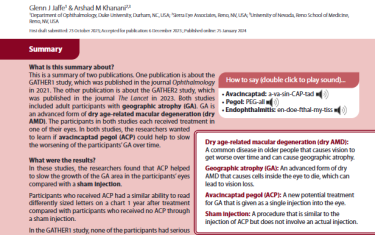
This is a summary of two publications. One publication is about the GATHER1 study, which was published in the journal Ophthalmology in 2021. The other publication is about the GATHER2 study, which was published in the journal The Lancet in 2023. Both studies included adult participants with geographic atrophy (GA). GA is an advanced form of dry age-related macular degeneration (dry AMD). The participants in both studies each received treatment in one of their eyes. In both studies, the researchers wanted to learn if avacincaptad pegol (ACP) could help to slow the worsening of the participants’ GA over time.
25th Jan 2024

GATHER1 and GATHER2 studies: a plain language summary looking at whether avacincaptad pegol works and is safe in people with geographic atrophy

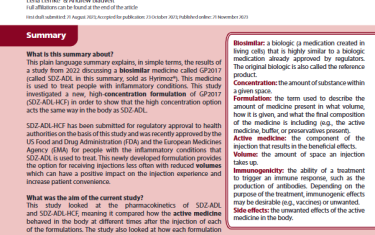
This plain language summary explains, in simple terms, the results of a study from 2022 discussing a biosimilar medicine called GP2017 (called SDZ-ADL in this summary, sold as Hyrimoz®). This medicine is used to treat people with inflammatory conditions. This study investigated a new, high-concentration formulation of GP2017 (SDZ-ADL-HCF) in order to show that the high concentration option acts the same way in the body as SDZ-ADL
22nd Jan 2024

Two different concentrations of GP2017 (a biosimilar medicine) are associated with similar drug levels in the body- a plain language summary

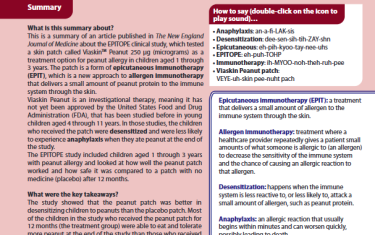
This is a summary of an article published in The New England Journal of Medicine about the EPITOPE clinical study, which tested a skin patch called ViaskinTM Peanut 250 μg (micrograms) as a treatment option for peanut allergy in children aged 1 through 3 years. The patch is a form of epicutaneous immunotherapy (EPIT), which is a new approach to allergen immunotherapythat delivers a small amount of peanut protein to the immune system through the skin
22nd Jan 2024

A plain language summary of epicutaneous immunotherapy with Viaskin™ Peanut in toddlers

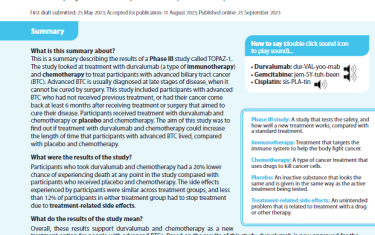
This is a summary describing the results of a Phase III study called TOPAZ-1. The study looked at treatment with durvalumab (a type of immunotherapy) and chemotherapy to treat participants with advanced biliary tract cancer (BTC). Advanced BTC is usually diagnosed at late stages of disease, when it cannot be cured by surgery. This study included participants with advanced BTC who had not received previous treatment, or had their cancer come back at least 6 months after receiving treatment or surgery that aimed to cure their disease. Participants received treatment with durvalumab and chemotherapy or placebo and chemotherapy. The aim of this study was to find out if treatment with durvalumab and chemotherapy could increase the length of time that participants with advanced BTC lived, compared with placebo and chemotherapy.
6th Oct 2023

The TOPAZ-1 study: a plain language summary describing durvalumab and chemotherapy for advanced biliary tract cancer

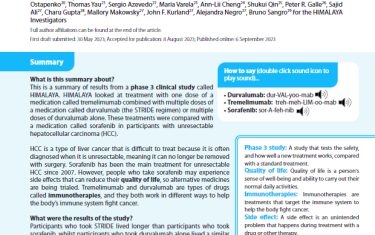
This is a summary of results from a phase 3 clinical study called HIMALAYA. HIMALAYA looked at treatment with one dose of a medication called tremelimumab combined with multiple doses of a medication called durvalumab (the STRIDE regimen) or multiple doses of durvalumab alone. These treatments were compared with a medication called sorafenib in participants with unresectable hepatocellular carcinoma (HCC).HCC is a type of liver cancer that is difficult to treat because it is often diagnosed when it is unresectable, meaning it can no longer be removed with surgery. Sorafenib has been the main treatment for unresectable HCC since 2007. However, people who take sorafenib may experience side effects that can reduce their quality of life, so alternative medicines are being trialed. Tremelimumab and durvalumab are types of drugs called immunotherapies, and they both work in different ways to help the body’s immune system fight cancer
22nd Sep 2023

A plain language summary of the HIMALAYA study which looked at tremelimumab and durvalumab for unresectable hepatocellular carcinoma

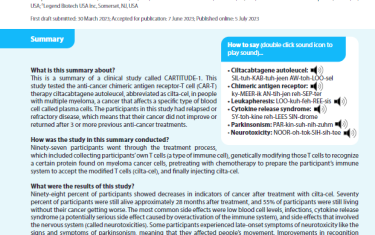
This is a summary of a clinical study called CARTITUDE-1. This study tested the anti-cancer chimeric antigen receptor-T cell (CAR-T ) therapy ciltacabtagene autoleucel, abbreviated as cilta-cel, in people with multiple myeloma, a cancer that affects a specific type of blood cell called plasma cells. The participants in this study had relapsed or refractory disease, which means that their cancer did not improve or returned after 3 or more previous anti-cancer treatments.
11th Jul 2023

Plain Language Summary: the CARTITUDE-1 study of ciltacabtagene autoleucel for the treatment of people with relapsed or refractory multiple myeloma

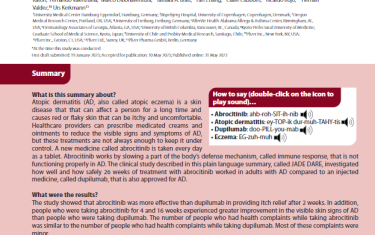
Atopic dermatitis (AD, also called atopic eczema) is a skin disease that that can affect a person for a long time and causes red or flaky skin that can be itchy and uncomfortable. Healthcare providers can prescribe medicated creams and ointments to reduce the visible signs and symptoms of AD, but these treatments are not always enough to keep it under control. A new medicine called abrocitinib is taken every day as a tablet. Abrocitinib works by slowing a part of the body’s defense mechanism, called immune response, that is not functioning properly in AD. The clinical study described in this plain language summary, called JADE DARE, investigated how well and how safely 26 weeks of treatment with abrocitinib worked in adults with AD compared to an injected medicine, called dupilumab, that is also approved for AD
2nd Jun 2023

Plain Language Summary: comparing how well abrocitinib and dupilumab treat atopic dermatitis signs and symptoms

12th Apr 2023

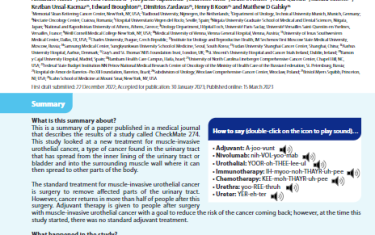
Plain Language Summary: the CheckMate 274 study, treatment of muscle-invasive urothelial cancer with nivolumab

Copyright © 2026 · Plain Language Summaries · Terms and conditions · Privacy policy · Cookie policy