Plain Language Summaries is part of Taylor & Francis Group.

  • Taylor & Francis
  • About us
  • Our journals
  • Our Digital Hubs

Taylor & Francis Group is a trading division of Informa that operates through various Informa legal entities including, but not limited to, Informa UK Limited, with the registered address at 5 Howick Place, London, SW1P 1WG, UK.

Taylor & Francis
logo
 
  • How to
  • FAQs
  • Publications
  • Advisory Panel
    • Plain Language Advisors
    • Scientific Content Advisors
  • Supporters
  • Blog
  • About us
  • Contact Us

clinical trials

28th Nov 2025

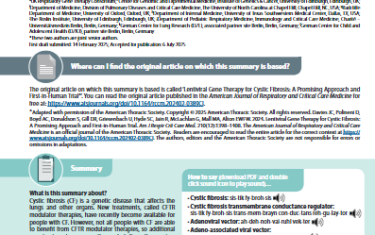
Cystic fibrosis plain language summary: exploring gene therapy possibilities

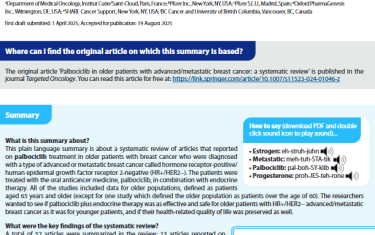
Screenshot of a summary article on palbociclib treatment for advanced/metastatic breast cancer in older patients, with key findings, how-to guide for downloading, and publication details.
19th Sep 2025

Plain language summary looking at palbociclib treatment for advanced breast cancer in older patients

27th May 2025

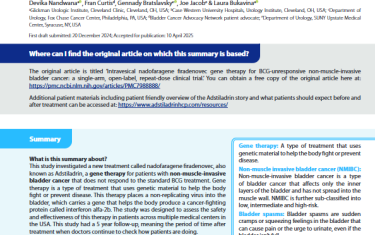
Plain language summary: Five-year results of nadofaragene firadenovec gene therapy for BCG-unresponsive non-muscle-invasive bladder cancer

20th May 2025

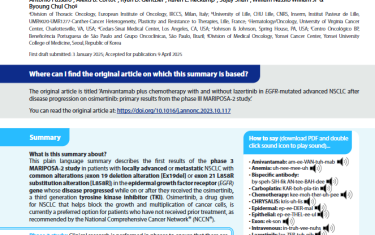
A plain language summary: MARIPOSA-2 study of amivantamab combinations for non-small-cell lung cancer

22nd Apr 2025

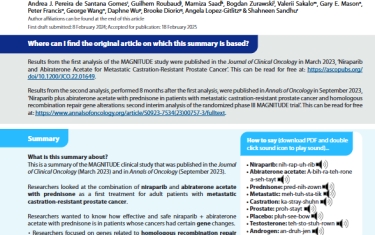
Plain language summary of the MAGNITUDE study on niraparib and abiraterone treatment for advanced prostate cancer

26th Mar 2025

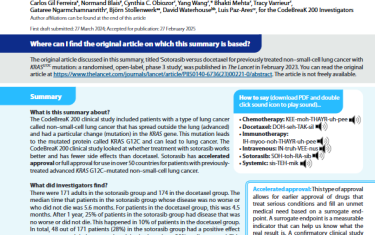
Plain language summary: Sotorasib vs. docetaxel for treated KRAS G12C–mutated non–small–cell lung cancer

17th Mar 2025

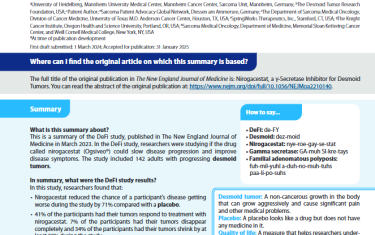
A plain language summary of the DeFi study: evaluating the effectiveness and safety of nirogacestat in adults with desmoid tumors

21st Feb 2025

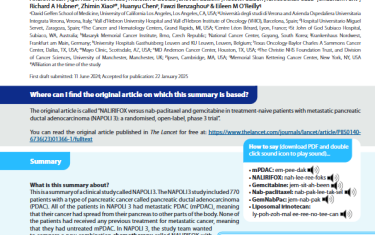
Plain language summary of the NAPOLI 3 study: comparing NALIRIFOX with nab-paclitaxel and gemcitabine for metastatic pancreatic cancer

11th Feb 2025

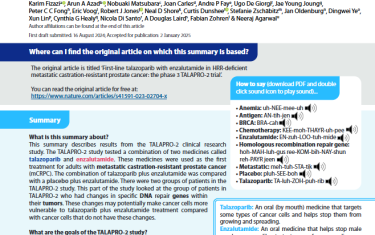
Plain language summary of the TALAPRO-2 study: Talazoparib plus enzalutamide versus placebo plus enzalutamide for advanced prostate cancer with specific DNA repair gene alterations

23rd Jan 2025

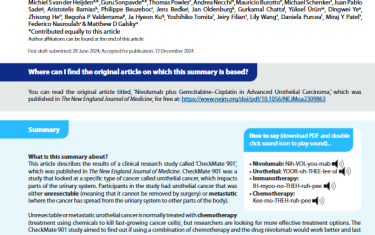
A plain language summary of the CheckMate 901 study: nivolumab combined with chemotherapy versus chemotherapy alone for advanced urothelial cancer

22nd Jan 2025

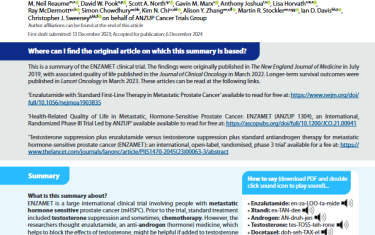
Plain language summary of the ENZAMET trial (ANZUP 1304): Enzalutamide combined with standard first-line therapy for metastatic hormone-sensitive prostate cancer

22nd Jan 2025

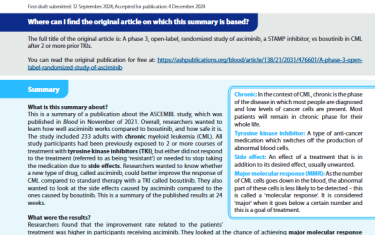
Plain language summary of the ASCEMBL study: comparing asciminib and bosutinib after multiple prior treatments for chronic myeloid leukemia

22nd Nov 2024

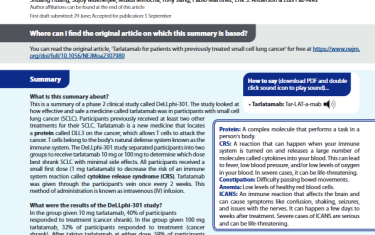
Plain language summary: tarlatamab for patients with previously treated small cell lung cancer

15th Nov 2024

The safety of relugolix combination therapy for advanced prostate cancer

15th Nov 2024

Quality of life in CheckMate 9ER: cabozantinib and nivolumab for advanced renal cell carcinoma

18th Oct 2024

Ruxolitinib treatment for polycythemia vera blood cancer: A plain language summary of the MAJIC-PV study

23rd Sep 2024

A plain language summary of the CAPItello-291 study: Capivasertib for advanced hormone receptor-positive breast cancer.

15th Aug 2024

Plain language summary of the CARTITUDE-4 study on ciltacabtagene autoleucel for treating relapsed or refractory multiple myeloma

30th Jul 2024

Plain language summary: N-803 plus BCG for BCG-naïve or unresponsive non-muscle invasive bladder cancer

30th Jul 2024

Plain language summary of TALAPRO-2 study: Talazoparib plus enzalutamide vs. placebo plus enzalutamide for advanced prostate cancer

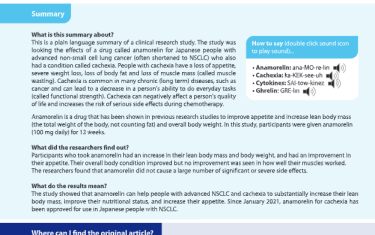
This is a plain language summary of a clinical research study. The studyinvestigated the effects of a drug called anamorelin for people in Japan withadvanced gastrointestinal cancer (colon, rectum, stomach or pancreas) whoalso had a condition called cachexia.People with cachexia have a loss of appetite, severe weight loss, loss of bodyfat, and loss of muscle. Anamorelin has been shown in previous researchstudies to improve appetite and increase lean body mass (the total weight of the body, not counting fat) and overall bodyweight. In this study, participants were given anamorelin (100 mg daily) for 12 weeks.
26th Jun 2024

Anamorelin for the treatment of people with gastrointestinal cancer and cachexia: A plain language summary

This is a plain language summary of a clinical research study. The study waslooking the effects of a drug called anamorelin for Japanese people withadvanced non-small cell lung cancer (often shortened to NSCLC) who alsohad a condition called cachexia. People with cachexia have a loss of appetite,severe weight loss, loss of body fat and loss of muscle mass (called musclewasting). Cachexia is common in many chronic (long term) diseases, such ascancer and can lead to a decrease in a person's ability to do everyday tasks(called functional strength). Cachexia can negatively affect a person's qualityof life and increases the risk of serious side effects during chemotherapy.Anamorelin is a drug that has been shown in previous research studies to improve appetite and increase lean body mass(the total weight of the body, not counting fat) and overall body weight. In this study, participants were given anamorelin(100 mg daily) for 12 weeks.
26th Jun 2024

Anamorelin for the treatment of Japanese people with non-small cell lung cancer and cachexia: A plain language summary

Sacituzumab govitecan (brand name: TRODELVY®) is a new treatment being studied for people with a type of bladder cancer, called urothelial cancer, that has progressed to a locally advanced or metastatic stage. Locally advanced and metastatic urothelial cancer are usually treated with platinum-based chemotherapy. Metastatic urothelial cancer is also treated with immune checkpoint inhibitors. There are few treatment options for people whose cancer gets worse after receiving these treatments. Sacituzumab govitecan is a suitable treatment option for most people with urothelial cancer because it aims to deliver an anti-cancer drug directly to the cancer in an attempt to limit the potential harmful side effects on healthy cells. This is a summary of a clinical study called TROPHY-U-01, focusing on the first group of participants, referred to as Cohort 1. All participants in Cohort 1 received sacituzumab govitecan
30th Apr 2024

Sacituzumab govitecan use in people with locally advanced or metastatic urothelial cancer- a plain language summary of the TROPHY-U-01 study

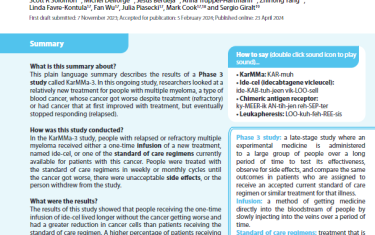
This plain language summary describes the results of a Phase 3 study called KarMMa-3. In this ongoing study, researchers looked at a relatively new treatment for people with multiple myeloma, a type of blood cancer, whose cancer got worse despite treatment (refractory) or had cancer that at first improved with treatment, but eventually stopped responding (relapsed)
30th Apr 2024

KarMMa-3 study: A plain language summary looking at the effectiveness of ide-cel for relapsed/refractory multiple myeloma

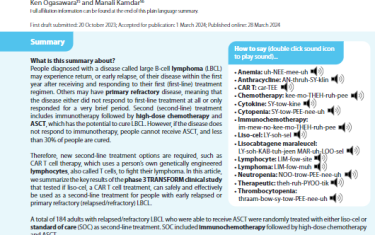
eople diagnosed with a disease called large B-cell lymphoma (LBCL) may experience return, or early relapse, of their disease within the first year after receiving and responding to their first (first-line) treatment regimen. Others may have primary refractory disease, meaning that the disease either did not respond to first-line treatment at all or only responded for a very brief period. Second (second-line) treatment includes immunotherapy followed by high-dose chemotherapy and ASCT, which has the potential to cure LBCL. However, if the disease does not respond to immunotherapy, people cannot receive ASCT, and less than 30% of people are cured.Therefore, new second-line treatment options are required, such as CAR T cell therapy, which uses a person’s own genetically engineered lymphocytes, also called T cells, to fight their lymphoma. In this article, we summarize the key results of the phase 3 TRANSFORM clinical studythat tested if liso-cel, a CAR T cell treatment, can safely and effectively be used as a second-line treatment for people with early relapsed or primary refractory (relapsed/refractory) LBCL
30th Apr 2024

A plain language summary on the TRANSFORM study: liso-cel as a second treatment regimen for large B-cell lymphoma

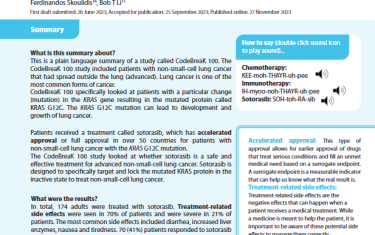
This is a plain language summary of a study called CodeBreaK 100. The CodeBreaK 100 study included patients with non-small-cell lung cancer that had spread outside the lung (advanced). Lung cancer is one of the most common forms of cancer.CodeBreaK 100 specifically looked at patients with a particular change (mutation) in the KRAS gene resulting in the mutated protein called KRAS G12C. The KRAS G12C mutation can lead to development and growth of lung cancer.
22nd Jan 2024

A plain language summary looking at the long-term benefit of sotorasib in patients with KRAS G12C–mutated non–small-cell lung cancer

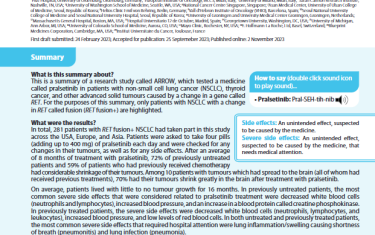
This is a summary of a research study called ARROW, which tested a medicine called pralsetinib in patients with non-small cell lung cancer (NSCLC), thyroid cancer, and other advanced solid tumours caused by a change in a gene called RET. For the purposes of this summary, only patients with NSCLC with a change in RET called fusion (RET fusion+) are highlighted
14th Nov 2023

A plain language summary of the ARROW study: pralsetinib in patients with RET fusion–positive non-small cell lung cancer

ESMO 2023 round-up
30th Oct 2023

ESMO 2023 round-up: addressing clinical trial disparities and solutions

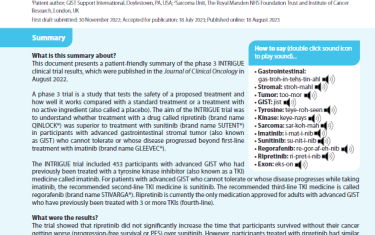
This document presents a patient-friendly summary of the phase 3 INTRIGUE clinical trial results, which were published in the Journal of Clinical Oncology in August 2022. A phase 3 trial is a study that tests the safety of a proposed treatment and how well it works compared with a standard treatment or a treatment with no active ingredient (also called a placebo). The aim of the INTRIGUE trial was to understand whether treatment with a drug called ripretinib (brand nameQINLOCK®) was superior to treatment with sunitinib (brand name SUTENT®) in participants with advanced gastrointestinal stromal tumor (also known as GIST) who cannot tolerate or whose disease progressed beyond first-line treatment with imatinib (brand name GLEEVEC®). The INTRIGUE trial included 453 participants with advanced GIST who had previously been treated with a tyrosine kinase inhibitor (also known as a TKI) medicine called imatinib. For patients with advanced GIST who cannot tolerate or whose disease progresses while taking imatinib, the recommended second-line TKI medicine is sunitinib. The recommended third-line TKI medicine is called regorafenib (brand name STIVARGA®). Ripretinib is currently the only medication approved for adults with advanced GIST who have previously been treated with 3 or more TKIs (fourth-line).
11th Sep 2023

A plain language summary of the INTRIGUE study comparing ripretinib with sunitinib in people with advanced gastrointestinal stromal tumour after treatment with imatinib

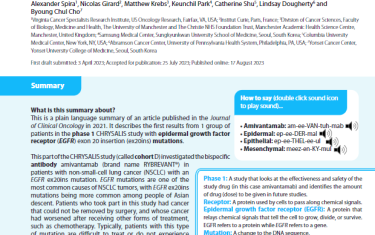
his is a plain language summary of an article published in the Journal of Clinical Oncology in 2021. It describes the first results from 1 group of patients in the phase 1 CHRYSALIS study with epidermal growth factorreceptor (EGFR) exon 20 insertion (ex20ins) mutations. This part of the CHRYSALIS study (called cohort D) investigated the bispecific antibody amivantamab (brand name RYBREVANT®) in patients with non-small-cell lung cancer (NSCLC) with an EGFR ex20ins mutation. EGFR mutations are one of the most common causes of NSCLC tumors, with EGFR ex20ins mutations being more common among people of Asian descent. Patients who took part in this study had cancer that could not be removed by surgery, and whose cancer had worsened after receiving other forms of treatment, such as chemotherapy. Typically, patients with this type of mutation are difficult to treat or do not experience treatment response with commonly used therapies that target EGFR.
17th Aug 2023

Plain Language Summary: looking at patients with EGFR exon 20 insertion-mutated non-small-cell lung cancer who received amivantamab in the CHRYSALIS study

Copyright © 2026 · Plain Language Summaries · Terms and conditions · Privacy policy · Cookie policy